
In ancient Polynesian cultures, sexuality was not a private or taboo matter — it was a sacred act tied to the regeneration of nature and divine power. Sexual relations, fertility, and virginity carried deep cosmological significance: they were the means by which gods and human beings renewed their alliance to perpetuate life. This worldview was systematically misread by European chroniclers of the 18th and 19th centuries, who interpreted it through a Western moral lens that had nothing to do with the Polynesian reality.
A misread history — how Europeans misunderstood Polynesian sexuality
The real understanding of Polynesian culture has been very slow. Stories, drawings and even photographs of explorers, navigators, missionaries and other visitors of the eighteenth and nineteenth centuries have been assumed as real and objective and have rarely been questioned. The natives were represented according to a stereotype, usually dressed in native costumes and certain ornaments that demonstrated their exoticism. Women were described as ‘a naked Venus before the Phrygians’ — an opinion issued by Bougainville regarding women in Tahiti, which served to underline the sexual availability and promiscuity of Polynesian women.
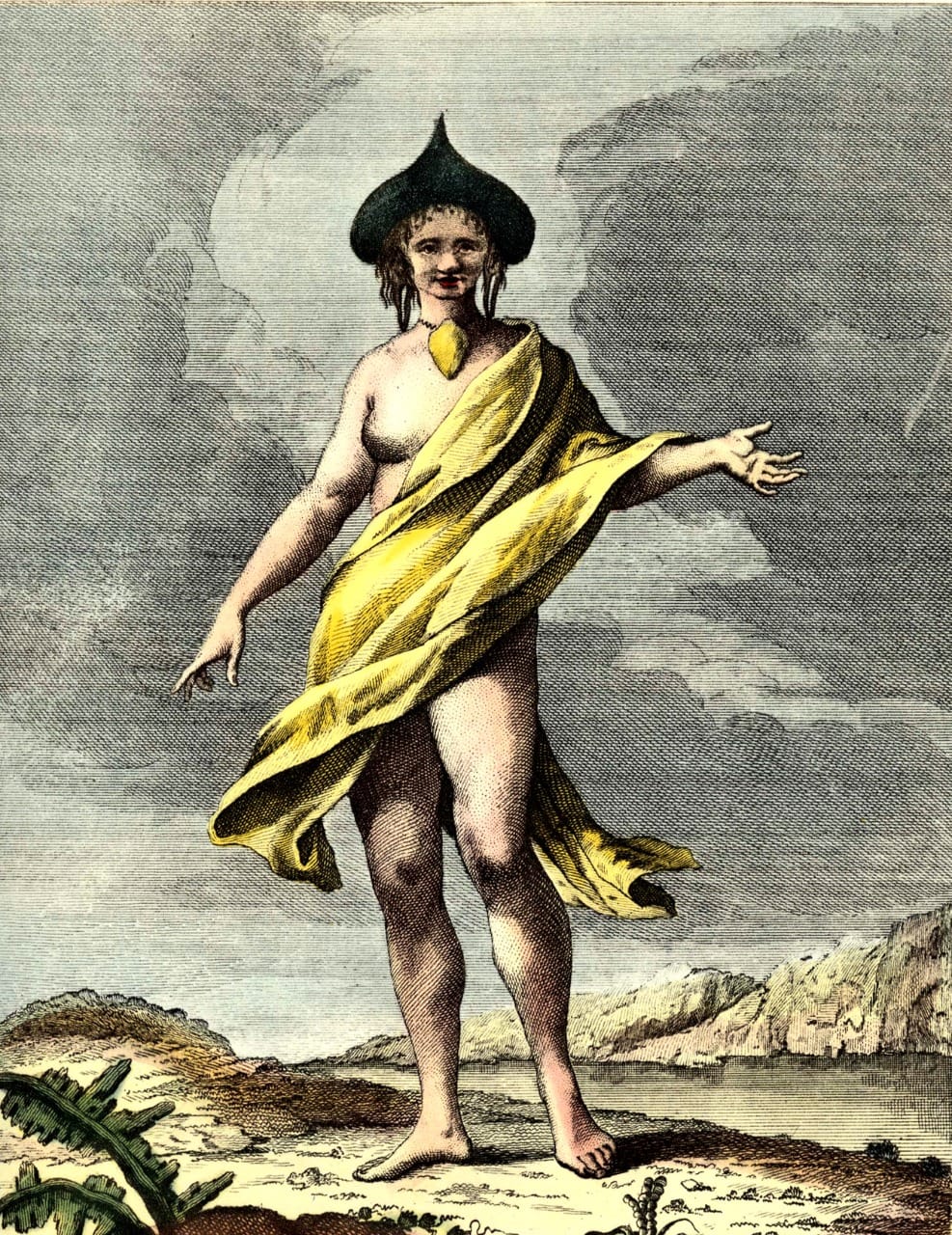
The objectives of the first European visitors of Rapa Nui, without a doubt, were not limited to the supply of ships. Sexual trafficking with native women was also among their aims. We often read that women were attractive and friendly and volunteered to sailors (Arredondo, 2000). However, a careful reading of the chronicles of the Dutch (1722), the Spanish expedition of 1770, and Cook and the naturalists Johann and George Forster in 1774, allow these claims to be questioned.
Roggeveen in 1722 emphasizes that only two or three older women approached the ship, and that no young woman or girl did. Captain Behrens, of the same expedition, indicates that older women dressed in red and white cloths sat in front of them and undressed, that they were cheerful and friendly. He also relates that others signaled them to invite them to approach the houses. Agüera e Infanzón (Mellén Blanco, 1986), officer of the ship Santa Rosalía, reports that ‘they insistently demonstrated what each one could offer a man.’ In his opinion, it was the older women, the elder midwives, who always accompanied and presented the younger women. Cook in 1774 observed few women and noted that they were kept inside the houses under the care of an older man.
Surely these observations were influenced by the wishes and fears of Europeans and written through a Western, non-Polynesian lens. The importance of the reproduction of life, of fecundity and sexual symbolism in ancestral Polynesian societies was clear, and its manifestation explicit. These were societies in which relationships were constantly being created through practice — especially sexual practice.

The sexual act as a sacred bond between the divine and the human
Polynesian ethnographic records indicate that spirits or deities are physically related to humans, especially through sexual intercourse. The importance of the sexual act was key, being the very representation of the regeneration of nature. The physical and sexual bond is positioned as an act linked to the sacred, where the divine and the earthly united to create life. Sex is the way to perpetuate life — both for the gods and for people, and many times between them.
A common practice was the forced presentation of virgin girls who were to marry a high chief. In ritual dances, the front row was reserved for young virgins. What was the special importance of virginity in all these cases? It has to do with the first child. The first son belonged to the community. The first child born to a high-ranking woman in Tahiti is known as matahiapo, which means ‘born from under the bark cloth’ (mahute). The mahute, like feathers, is the clothing of the gods and even a ‘way’ for the gods to come down to earth. Sacred objects were also wrapped in mahute throughout Polynesia.
Across Polynesia, the idea and practice of theogamy was sustained: a girl, without necessarily having reached puberty, is presented in marriage to foreigners arriving from the horizon — the place of ancestors and the symbolic residence of the divinities. Cook in Hawaii describes: ‘at the precise moment that I jumped ashore, everyone fell on their faces and remained in this position of compliance until I signaled them to get up.’ The fact of having arrived from the horizon and from the direction of the sunset associated foreigners with the Po, the primordial darkness.
The white color is the color of the sun and these white men, powerful in their ships with white sails, capable of emitting fire and thunderous noises like the gods, were received as the personification of the divinities. Consequently the Polynesians wanted to relate to them through the generative powers they shared. From this point of view, Polynesian cosmology demands the presence of a female being who had not yet given birth, to create a child with divine properties.

The Komari and sacred sexuality in Rapa Nui
On Rapa Nui, this sacred vision of sexuality and fertility found a unique expression in the rock art of the ceremonial village of Orongo. Among the more than 1,800 petroglyphs carved into the rocks of the Mata Ngarau — the sacred area of Orongo — one of the most frequently recurring symbols is the Komari: the representation of the female vulva as a symbol of fertility, creation, and divine power.
The Komari was not an obscene symbol. It was a cosmological statement: the capacity to give life was the closest act to the divine that existed. The petroglyphs at Orongo show the Komari alongside the god Make-Make and the Tangata Manu (the Bird-Man), as part of the same ritual system that governed the annual renewal of the natural cycle. Fertility, political power, and divinity were represented in the same ceremonial space — as a single idea.
This connection between sexuality, worldview and ritual was not unique to Rapa Nui. It was the local expression of a shared Polynesian belief system spread across the Pacific — one that 19th-century missionaries worked systematically to eradicate, with devastating consequences for the oral transmission of these traditions.
The ceremonial village of Orongo | The Tangata Manu Bird-Man cult
Mana, fertility, and social order
To understand the role of sexuality in Polynesian cosmology, it is essential to understand the concept of Mana. Mana is a spiritual force that permeates people, objects and places in varying degrees. Chiefs, priests and high-ranking warriors possessed great Mana — and that spiritual force was transmitted, among other ways, through lineage: that is, through reproduction.
The firstborn child of a high-ranking chief was therefore a being of exceptional spiritual power — the bearer of accumulated ancestral Mana and of the divine power of the father. This is precisely why a mother’s virginity mattered so greatly: the first sexual bond with a woman with no reproductive history ensured that the firstborn carried no other man’s Mana. In cosmological terms, it was a pure being, fully capable of receiving spiritual force at its highest intensity.
This system explains why the presentation of young women to European explorers was, for Polynesians, an act of honor and power: they were offering their newly arrived divinities from the horizon the opportunity to generate a child with supernatural properties. It was not submission. It was cosmology in action.
The origins of the Polynesians | Polynesian gods and Rapa Nui mythology
Frequently Asked Questions about sex and religion in Polynesia
What is theogamy in Polynesian culture?
Theogamy is the practice of sexual or marital union between human beings and divine figures. In ancestral Polynesian culture, foreigners arriving from the ocean horizon were frequently identified as divine beings or ancestors, making sexual union with them a sacred act: the goal was to create a child with superior spiritual properties.
What is the Komari in Rapa Nui?
The Komari is the symbol of the female vulva, represented in hundreds of petroglyphs on Rapa Nui — especially at the ceremonial village of Orongo. It is not an obscene symbol but a cosmological sign of fertility, creation and divine power. It appears alongside the god Make-Make and the Bird-Man as part of the ritual system governing the island’s annual cycle of renewal.
What is Mana and how does it relate to sexuality?
Mana is the spiritual force that, according to Polynesian cosmology, permeates people, objects and places in varying degrees. It is transmitted through lineage and reproduction, making the firstborn child of a high-ranking chief a being of exceptional spiritual power. This explains the importance of virginity and the practice of theogamy in ancestral Polynesian culture.
Why did European chroniclers misunderstand Polynesian sexuality?
European chroniclers of the 18th and 19th centuries observed Polynesian practices through a Western moral lens fundamentally different from the Polynesian worldview. The ritual presentation of young women to visitors — which for Polynesians was an act of cosmological honor — was interpreted as promiscuity or sexual availability. This distortion shaped decades of academic literature on Polynesia.
How was sexuality connected to religion in ancient Polynesia?
In ancient Polynesian societies, the sexual act was considered the earthly representation of divine creation — the union of the sacred and the earthly to perpetuate life. Fertility rituals, sacred virginity, theogamy and the veneration of fertility symbols like the Komari on Rapa Nui were all expressions of a unified cosmological system in which sexuality and divinity were inseparable.


