
By Eduardo A. Flores, ESMOI Center, Catholic University of the North.
When we think of Rapa Nui, we probably imagine its moai, volcanoes, cliffs, and the vast ocean surrounding the island. From the shore, the Pacific appears to be endless, empty surface. But beneath that seemingly infinite blue lies another landscape: a gigantic underwater mountain range, formed by seamounts, volcanoes, and ridges stretching across thousands of kilometers.
Some of these mountains have never seen sunlight. They lie hundreds of meters below the surface and yet can be essential to the life inhabiting the deep ocean.
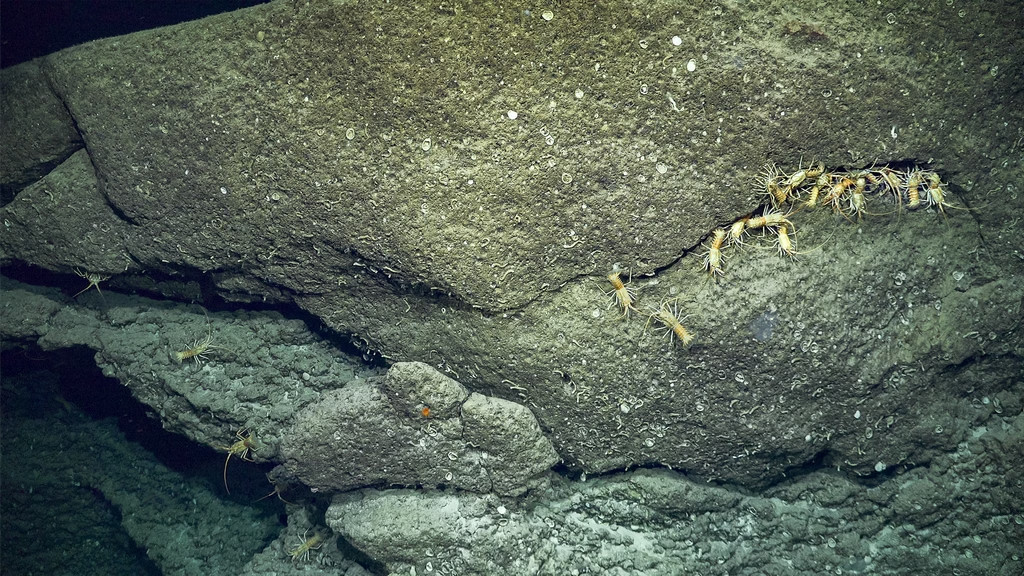
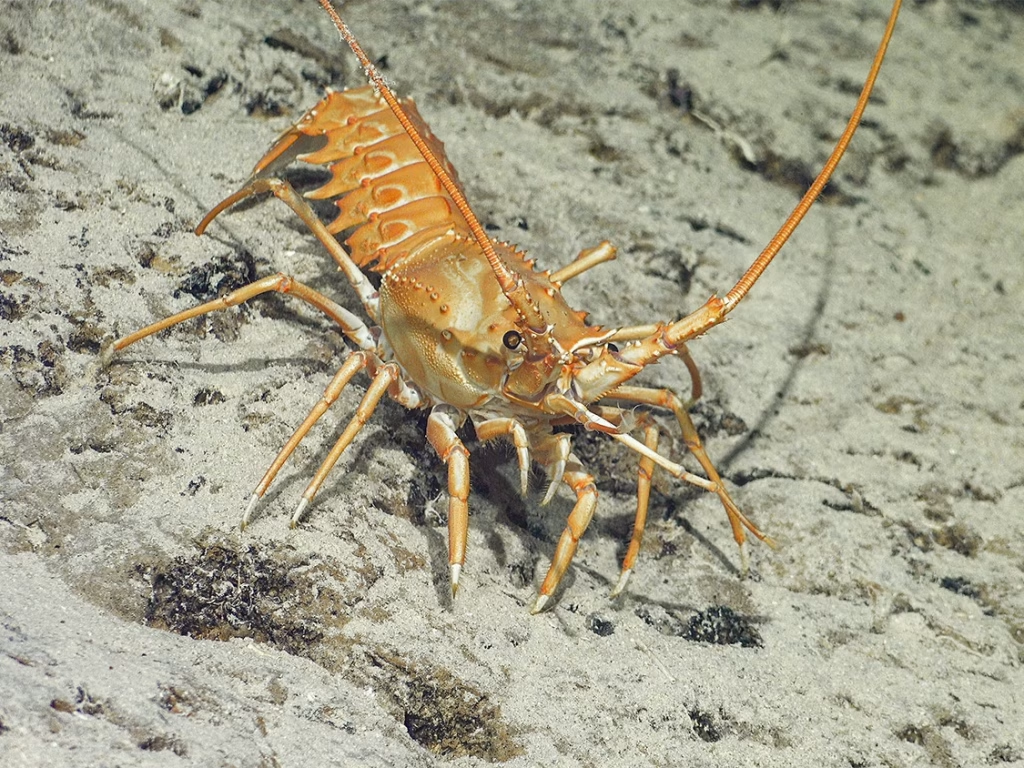
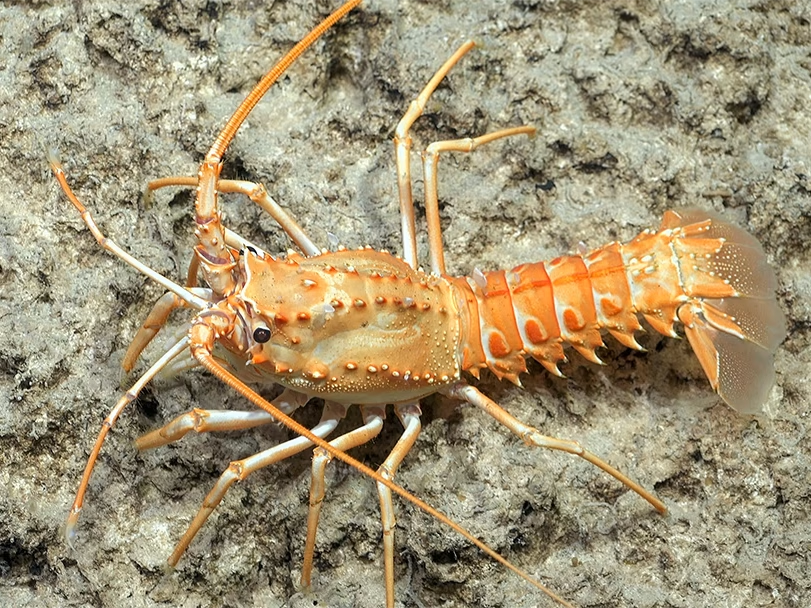
One of the species helping us uncover this hidden story is a remarkable lobster: Projasus bahamondei, commonly known as the jagged lobster, a close cousin of the Easter Island spiny lobster, Panulirus pascuensis, and the Juan Fernández rock lobster, Jasus frontalis. This species lives in deep environments, associated with underwater ridges and seamounts. It has been found along the Nazca, Salas & Gómez, and Juan Fernández ridges, around the Desventuradas Islands, and on isolated seamounts such as O’Higgins and Solito.
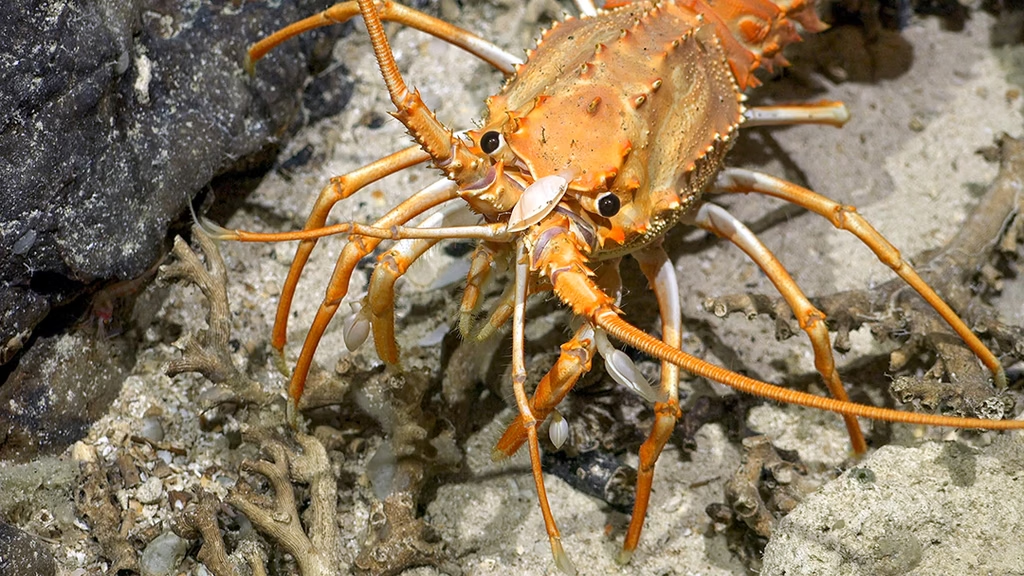
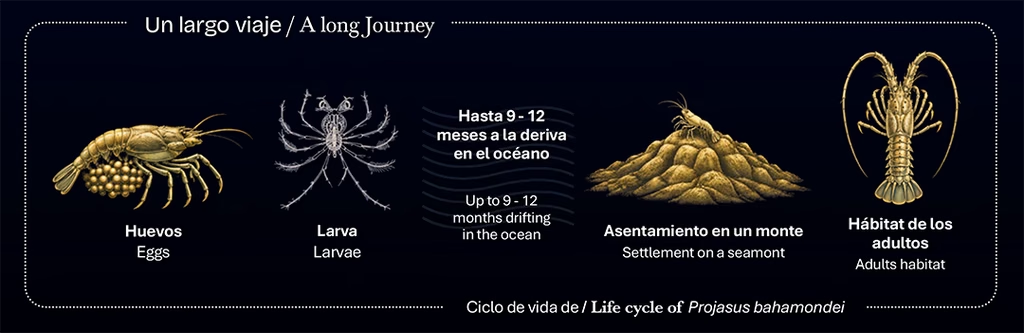
But this is where the truly fascinating part begins. How can a species associated with deep seafloor inhabit places separated by hundreds or even thousands of kilometers of open ocean? The answer lies in a stage of its life that takes place far from the seafloor: its larvae.
Although we still do not know exactly how long P. bahamondei remains it larval stage, related species within the spiny lobster family can spend several months, and sometimes more than a year, drifting in the ocean. To explore their potential journeys, our study considered a period of nine to twelve months. During this time, tiny larvae can be transported by ocean currents before eventually finding a suitable place to settle.
Imagine, then, a newly hatched larva leaving one of these underwater mountains. It has no map. It does not know where Salas & Gómez, Juan Fernández, or the Desventuradas Islands are. Nor can it decide where to swim across hundreds of kilometers. Its journey depends largely on the currents.
And the currents of the Pacific are not simple rivers flowing in a straight line.
The ocean is filled with enormous swirling structures known as eddies or vortices, some of which can extend across tens of kilometers. Certain eddies slowly move westward, carrying water masses, heat, nutrients, and organisms across the ocean. Others form filaments and pathways that stretch and transport whatever they encounter along way. In our study, we found that these processes can function as genuine “highways” for lobster larvae.
Thus, what appears from the surface to be an empty ocean can become, for a tiny larva, a complex system of invisible roads.
And this is where the seamounts come in. The system formed by the Salas & Gómez and Nazca ridges extends for more than 4,000 kilometers and connects the Desventuradas Islands with Rapa Nui beneath the ocean surface. Together with the Juan Fernández Ridge, it forms one of the great geographical structures of the Southeast Pacific and supports ecosystems with extraordinary biodiversity, including numerous endemic species.
These underwater mountains can act as “stepping stones”. This does not mean that larvae literally jump from one mountain to another as if crossing a bridge. Rather, in the middle of vast stretches of open ocean, these environments can provide places where populations persist and from which new generations can continue their journey.
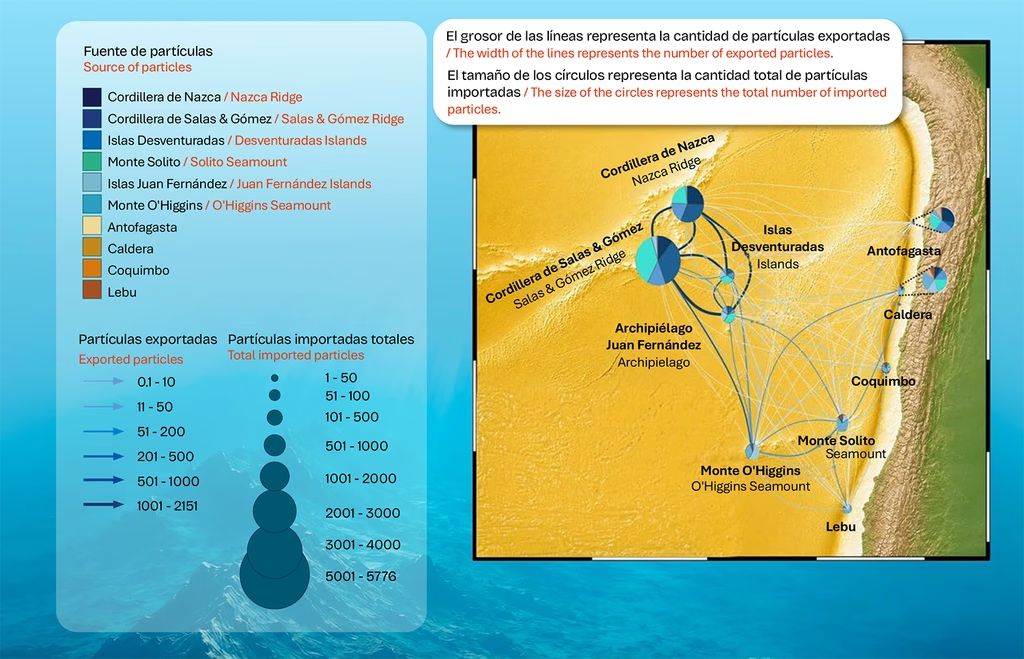
Our study allowed us to observe this network of connections through a virtual experiment. Over 16 years of oceanographic conditions, from 2009 to 2024, we simulated the journey of more than three million particles representing Projasus bahamondei larvae.
The result was surprising. Oceanic populations were much more strongly connected to one another than to the continental margin. Among the areas we studied, the Salas & Gómez Ridge and the Solito Seamount stood out as particularly important. The latter, located approximately 850 kilometers off the Chilean coast, proved to be especially significant: larvae originating there traveled hundreds of kilometers and showed the highest transport success within the system we studied.
Solito therefore appears to function somewhat like a station in the middle of the ocean: it receives larvae from other places and, at the same time, can become a source from which new generations continue their journey. But the story has a twist.
Not all routes are easy. The ocean off Chile contains a transition zone characterized by intense eddy and frontal activity that can make movement from the coast toward the open ocean difficult. In fact, in our simulations, particles originating from the continental margin traveled much shorter distances than those originating from oceanic habitats. While continental particles generally moved only tens to a few hundred kilometers, particles released from some seamounts traveled much farther.
This means that connectivity between ecosystems is not equal in every direction. There are invisible borders in the ocean, too.
For us, this discovery changes the way we look at places such as Rapa Nui. The island cannot be understood simply as an isolated point in the middle of the Pacific. Its surrounding waters are part of much larger network of oceanic ecosystems connected by currents, seamounts, and processes occurring hundreds of meters below the surface.
The small Projasus bahamondei lobster tells precisely this story.
Its journey shows that ocean conservation cannot simply focus on protecting isolated places. If a population depends on larvae arriving from another seamount hundreds of kilometers away, protecting only the places where adults live may not be enough. To preserve the life of the ocean, we also need to protect the pathways that connect it.
Based on: Flores E.A., Gallardo M.A., Ramos M., Asorey C., Pizarro-Koch., Hammond M., Tapia-Guerra J.M., Bravo L., Véliz D., Gaymer C.F., and Sellanes J. Unraveling connectivity pathways of the jagged lobster Projasus bahamondei: oceanic hubs and transport barriers in the Southeast Pacific. Progress in Oceanography 246 (2026) 103764.


