
For the rapanui people, astronomical knowledge was as essential to survival as farming or navigation: archaeoastronomy on Rapa Nui studies exactly how that sky-watching was recorded in stone, in the orientation of dozens of ahu scattered across the island. Understanding the movements of the moon, sun, and stars was never idle curiosity it was calendar, ritual, and agriculture all at once.

The lunar calendar and ceremonial life
The rapanui month followed the phases of the moon, from Ohiro (new moon) to Omotohi (full moon), setting the rhythm for planting, fishing, and celebration. The rise of the Pleiades Matariki after the winter solstice signaled the start of a new year, a milestone observed and passed down through generations.
In the Ana U’i He Tu’u cave, near the Tahai ceremonial center, markings linked to this astronomical observation have been identified. The stone Tupa towers also served as watchpoints over the sky and the horizon.

Ahu as solstice and equinox observatories
Astronomer William Liller revisited and expanded on William Mulloy’s measurements of 23 coastal ahu, confirming a predominant north-south orientation, while inland platforms face the winter solstice sunrise.
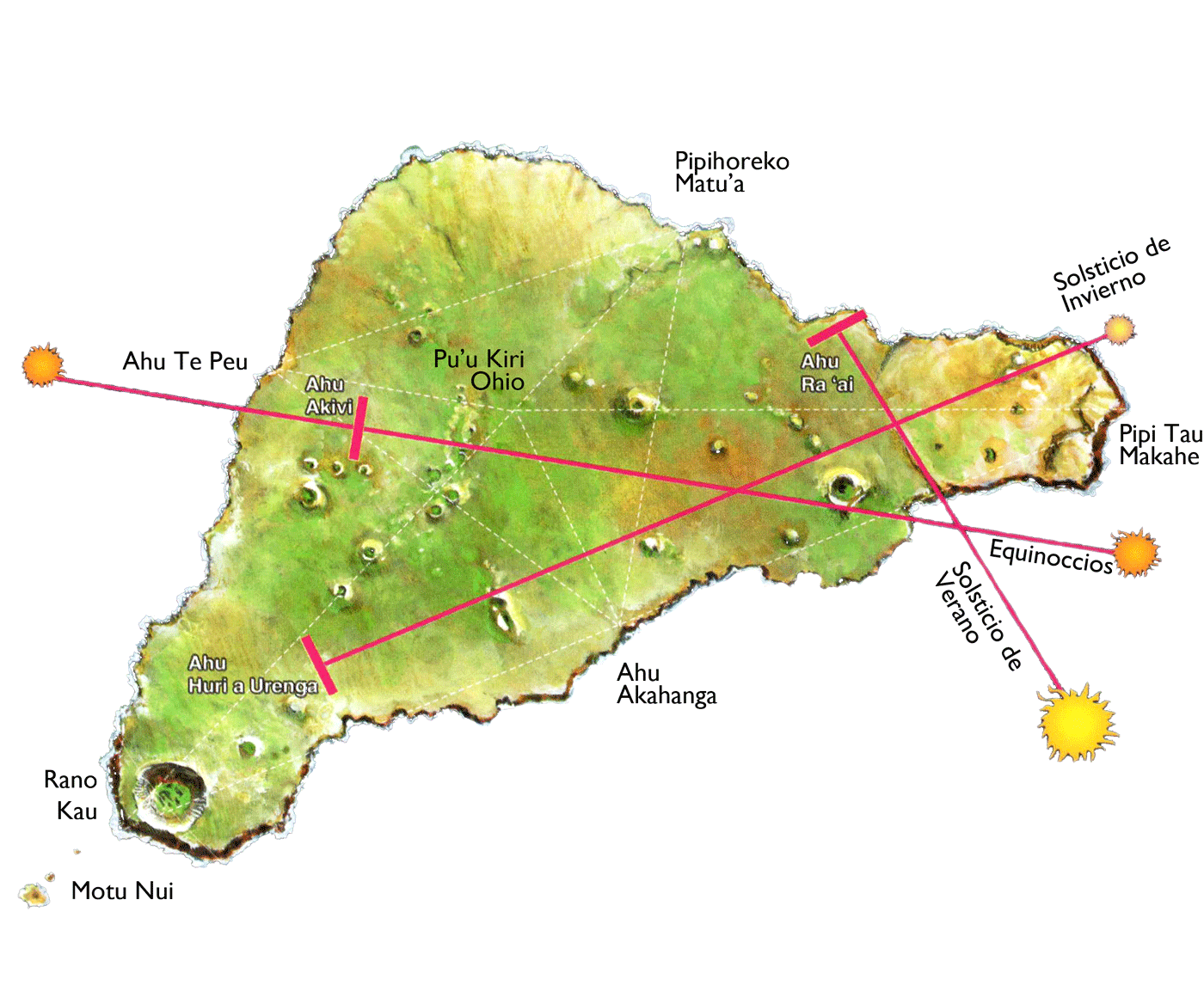
Ahu Ra’ai, aligned toward Poike and Pu’a Katiki, marks the summer solstice. At Ahu Tongariki, the same summer-solstice sunrise alignment reinforces the reading of a deliberate astronomical pattern in the placement of the moai.


Ahu Huri A Urenga: the winter solstice observatory
Between Puna Pau and Cerro Orito lies Ahu Huri A Urenga, a winter solstice observatory and one of the island’s most singular archaeoastronomical sites: its moai is the only one known with four hands. Ahu Akava on land belonging to governor Pedro Edmunds Paoa marks the winter solstice sunset, and Ahu Ko Te Pei, at 3,500 meters, functions as a triangulation point with other observatories.
Ahu Tahiri is linked to the equinoxes; Vinapu 2 and Ahu Ra’ai mark the summer solstice; Ahu Heki’i, the winter solstice.


Ahu dedicated to celestial bodies
In Akahanga bay stands Ahu Ura Uranga Te Mahina, whose name translates as “Red Moon,” and near Tahai, Ahu Moai A Mata Mea, the “Mars Moai.” Both monuments are interpreted as possible dedications to specific celestial bodies, a hypothesis that connects with the cosmology described in Polynesian gods and myths.
Petroglyphs at Papa U’i He Tu’u, on Poike, and at Papa Mahina, near Hanga Ho’onu (La Pérouse bay), reinforce this tradition of astronomical record-keeping in stone.


A new reading: Orion and the Pleiades
Recent research by Juan Antonio Belmonte and Edwin Edwards, covering 30 archaeoastronomical sites on the island, proposes a new interpretation: many orientations may respond not only to the equinoxes, but to the position of Tautoru (Orion’s Belt) and the Pleiades. This hypothesis resonates with the oral traditions preserved in the ceremonial calendar of Orongo, where sky-watching and the birdman cult are also intertwined.


Frequently asked questions about archaeoastronomy on Rapa Nui
What is archaeoastronomy on Rapa Nui?
It is the study of how the rapanui people used the observation of the moon, sun, and stars to organize their calendar, agriculture, and ceremonies, leaving that relationship carved into the orientation of their ahu.
Which ahu on Rapa Nui are aligned with the solstice?
Ahu Ra’ai and Ahu Tongariki mark the summer solstice; Ahu Huri A Urenga, Ahu Akava, and Ahu Heki’i mark the winter solstice; Ahu Tahiri is linked to the equinoxes.
What is the connection between the Pleiades and the rapanui calendar?
The rise of the Pleiades (Matariki) after the winter solstice traditionally marked the start of the rapanui new year.
Which ahu has the four-handed moai?
Ahu Huri A Urenga, located between Puna Pau and Cerro Orito, is the only one with a four-handed moai, and is also one of the island’s most distinctive solstice observatories.


2 Responses
Hi Moe
I just arrived on Easter Island today. I would like to know if there is someone here who I can hire for a solstice tour that you recommend? Thank you.-Ann
Hi Ann,
Welcome to Easter Island!
We highly recommend reaching out to Rapa Nui Experience for your solstice tour. You can check out what they offer and find their contact details on their website: Rapa Nui Experience Guide.
Feel free to explore their page and give them a call directly. Have a wonderful trip!