
By José Miguel Ramírez Aliaga Arqueólogo
Twenty years ago the Easter Island Archaeological Heritage Conservation Project was developed, under the direction of the National Monuments Council and the administration of Unesco’s Regional Office in Santiago, from a contribution of U$ 600.000 from the Government of Japan.
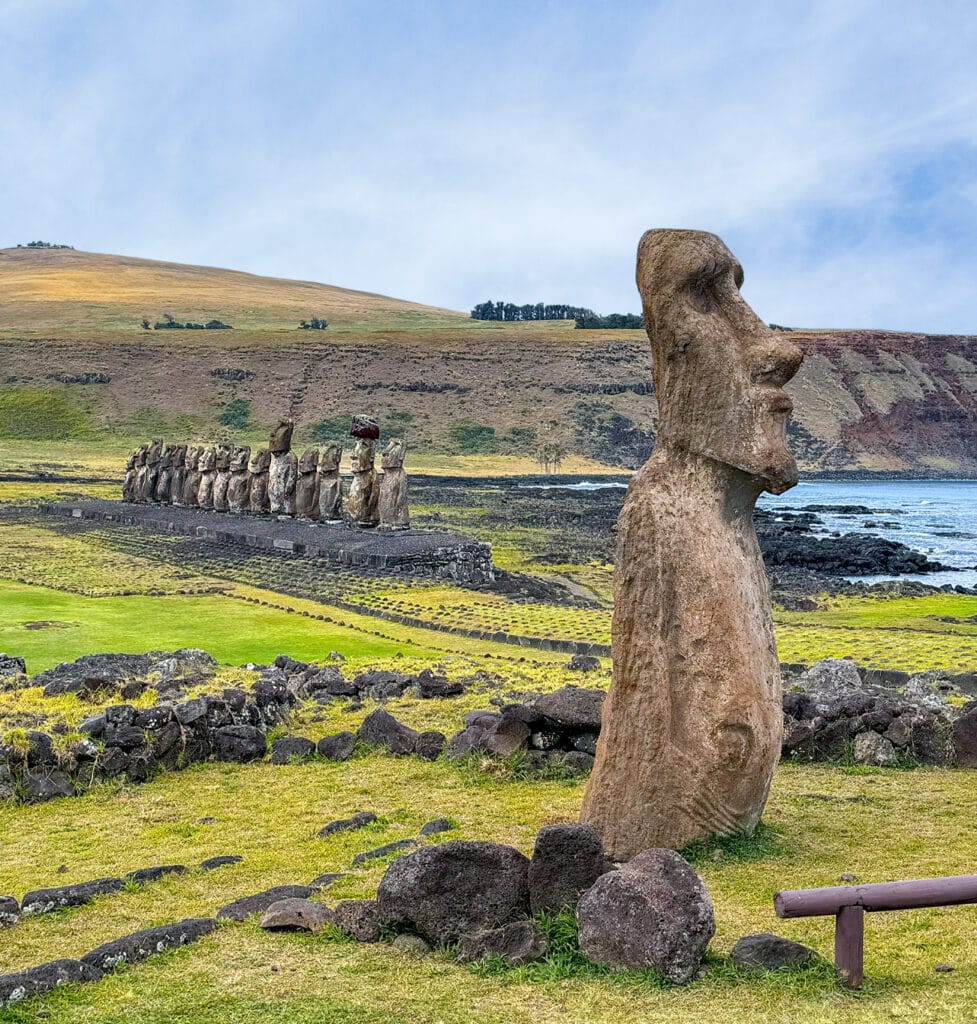
After intense conversations between national, international and local institutions and actors, the project materialized in several specific contributions, such as the Preventive Maintenance Program, the conservation of the Ahu Toŋariki moai, the implementation of a laboratory for the conservation of archaeological materials at MAPSE, and archaeological research at Ahu Ura Uraŋa te Mahina.
The work related to the conservation of moai and the laboratory were in charge of the specialists Mónica Bahamondez (CNCR), Paula Valenzuela (MAPSE) and Masaaki Sawada (University of Tsukuba), while the investigations at the Ahu Ura Uraŋa Te Mahina were directed by archaeologist William Ayres (University of Oregon), a prominent disciple of William Mulloy.

It is interesting to highlight the Preventive Maintenance Program, because it is a problem that is progressively affecting many archaeological sites on the island. The basic principle of preventive stabilization of areas with structural walls where the detachment of some blocks, or soil erosion, threatened a major collapse of the structure.
The Preventive Maintenance was programmed from a list initially drawn up and prioritized by Sergio Rapu, but had to be initiated in three small sites accessible to smaller machinery in Haŋa Te’e Bay, due to the difficulties in using the Tadano crane at the beginning of the program.

The execution of the the work was carried out by an exceptional Rapa Nui team under the direction of Rafael Rapu Haoa. This ability was evident in the rescue work of the moai and the stabilization of the huge cliff on the edge of Ahu Ruŋa Va’e. Then, in the Ahu Haŋa Teteŋa, different stabilization works were carried out in sectors of the back wall and in the eroded slope next to the back wall. At the end of the project, the Unesco regional office recognized Rafael Rapu Haoa as a legitimate heir of the ancient masters of monumental construction, a Maori aŋa ahu.

An exceptional case The Haŋa Hahave crematorium, whose rear wall had fallen due to the collapse of an ana kioŋa at the base of the wall. It was The largest crematorium of the classical ahu-moai period. Among the materials recovered from the pit included hundreds of calcined fragments of human bones, and a variety of artifacts.


Among these artifacts human bones we’re found with cuts that could correspond to preforms of an instrument, or with perforations to be used as ornaments, two small bonefish hooks, one of which presented an exceptionally fine design, three small toki, a fragment of maŋai mae’a, fragments of coral, two obsidian eyes that may have corresponded to anthropomorphic wooden images, and abundant obsidian fragments.
Among the abundant bones recovered there was evidence that some long bones had been fleshed before being subjected to cremation. Naturally, decreasing the mass would mean fuel saving, but some case of anthropophagy cannot be ruled out.


Unfortunately, the need to repair the platform and stabilize the front wall of Ahu Toŋariki prevented the completion of the work on the crematorium of Ahu Haŋa Hahave. For the past 20 years, rain has been destroying the exposed fill of the crematorium, causing the collapse of some of the chambers remaining on the surface, and displacing artifacts and remains of the tupuna down the slope.
Given the progressive advance erosion and the destabilization of the archaeological structures due to natural causes, Preventive Maintenance should be assumed as a permanent program, based on a periodic evaluation of the state of the monuments and the technical definition of priorities.


Erosion is a permanent and cumulative natural phenomenon, but it is also necessary to consider the possible catastrophic occurrence of tidal waves or “microtsunamis” in some of the most exposed sites, so that prevention should consider the prioritization of interventions in those places where the damages could be major and more expensive.
Among the many cases that have been pending preventive intervention for the last 20 years include Ahu Tepeu, Akahaŋa, Haŋa Poukura, Maitaki te Moa, Te Pito Kura, Vaihu, Huareva, the Ahu at Poike, etc. Among the many minor structures, we can mention the tupa of Te Ihu.

From the original lista,Rapu eventually rescued the Pakaia moai, and stabilized the back wall of Ahu Ura Uranga o Te Mahina, and periodically repaired the collapsed walls of the Orongo Ceremonial Village.
The Unesco-Japan Project did not consider the situation of the Ceremonial Village of Oroŋo, because it is a major structural problem. Even more serious is the case of the petroglyph blocks of Mata Ŋarahu (Xterrae 2013).

The collapse of sections of walls of some houses has been occurring periodically, basically due to the accumulation of water in the fill, increasing the pressure on the exterior walls in a way that generates a convex buckling to the point of collapse. The repair of these collapsed walls does not involve a major effort, but the structural damage to the interior of the houses was evaluated by a specialized company (ReStudio 2013), and in some cases the situation was quite serious.
Among the problems detected were the displacement of basal and horizontal slabs, fracture of slabs, collapse of wall sections and interior ceilings. In these cases, the intervention would be on a much larger scale, with the dismantling of a good part or a whole house in order to begin stabilization of the structure from the foundations, including the installation of reinforcement.
Damage caused by human causes is just as difficult, if not more so, to manage on the island, especially intentional fires. Beyond the relevance and visibility of the ahu and moai, preventive maintenance for the protection of thousands of minor structures can only be mowing the grass on the perimeter.

Ultimately, it is necessary to emphasize the need for any intervention to include an archaeological analysis of the site, in order to archaeological analysis of the site, in order to have a exhaustive record of the original work from it’s foundations, with dating data and the systematic recovery of multiple data and contexts. At the time, William Mulloy decided not to conduct the archaeological analysis at Oroŋo because he was concerned about restoring the monument for the impact of tourism, but times change.


