
Testimony from the Past by Josefina Arriagada
Ana María Arredondo’s history on Rapa Nui spans almost five decades — a period marked by her deep love for the island, its people, and its culture. Her life is a weaving together of the personal and professional, her commitment to the community, and her constant search for knowledge. She has written numerous books and publications on Rapanui culture, worked as a teacher, and directed the Liceo Aldea Educativa Hoŋa’a o Te Mana.
Her trajectory is a testament to how one person can transform their life upon finding a deeper purpose: the transmission of knowledge and the preservation of a cultural identity at risk.
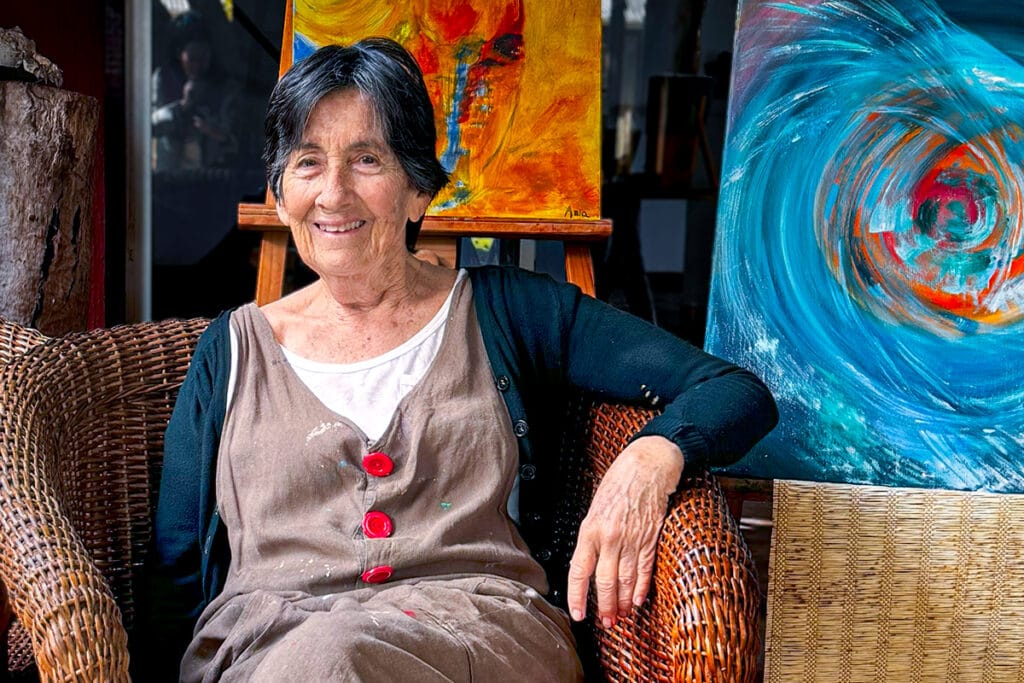
The Encounter with the Island: The Journey That Changed Everything
Ana María, originally from Viña del Mar, Chile, arrived on Rapa Nui for the first time in 1976. The island, at that time, was a place with a social dynamic and landscape very different from today, with little more than a thousand inhabitants. This intimate atmosphere and natural beauty captivated Ana María, who forged friendships that prompted her to return the following summer.
It was on that return when she met Bene — Benedicto Tuki Pate — a sculptor, fisherman, and diver. The encounter between them was magical: a love that seemed rooted in the very earth of the island. That connection was profound, real, and forever. “Since I arrived, I felt at home,” remembers Ana María. “I never experienced the need to ‘get used to’ Rapa Nui. I felt a deep connection with the energy of the place and its people.”

Forging Her Own Path: Teaching, Art, and Research
Although her initial dream was archaeology, Ana María studied history. However, Rapa Nui gave her the opportunity to connect with her passion for archaeology, allowing her to discover the historical and cultural richness that emanated from every stone.
Her professional path was not linear. She faced obstacles that tested her determination. With her friend Asunta Tuki, she created a kindergarten — a project that lasted a few years. Later, the Institute of Studies of Easter Island of the University of Chile offered her the opportunity to organize their bibliographic collection. Occasionally she participated in archaeological prospecting and the transfer of field cards.
In 1984, she participated in the First Congress of Anthropology and Archaeology of Easter Island and the Pacific — an event notable for its openness to the community, including the participation of young people, which distinguished it from other academic events. Her first research on Rapanui culture was in 1985, published in the “First Days of Art and Archaeology” of the Museum of Pre-Columbian Art: “Rapa nui Pectoral Ornament Represented in the Petroglyphs.”
Subsequently, she published several studies in scientific journals and books dedicated to the rescue of intangible heritage, many of them aimed at children and young people. In this way, research and teaching became her permanent vocation — a dedication she shares with other women who have documented the island’s living memory, such as Esperanza Pakarati Tepano.
Legacy and Commitment to Rapanui Culture
Ana María recognizes the importance of preserving Rapanui culture, especially in an increasingly globalized world. Her commitment to the island transcends academia. She believes that the transmission of culture is not limited to information, but involves the transmission of values and the strengthening of Rapanui identity in new generations — a spirit that also animates ancestral ceremonies such as the Tangata Manu.
As an art lover, she was always by Bene’s side, participating in his sculptural creations, exhibitions, and travels around the world. “Traveling with Bene was revealing,” she reflects. “We saw so many similarities with Rapanui culture and thought that in very remote times migratory movements toward the Pacific came from there, arriving at Rapa Nui.”


Building a Family on the Island
Ana María built a family life with Bene and their daughters Paula and Vai Iti. She describes her first years on the island as a great life experience. “Life on the island, in the beginning, was very different from the way of life on the mainland. We cooked with kerosene and sometimes made fire. We didn’t have a washing machine, so we washed clothes in a drum where we would stomp on them if they were very dirty. Bene plowed in front of the house and we planted everything we needed to live.”
The family was completed with their daughters, who always stood by her side. Today she has grandchildren — Nicolás, Agustín, Vicente — a granddaughter, Mikaela, and a great-grandson, Andrés. “The most wonderful thing has been my daughters, always by my side, and now my grandchildren. Bene was a good diver, so we never lacked fish at the table.”

The Inner Journey: Fulfilling Dreams at Sixty
Many have been her dreams, and some of them remained in time and came true. At sixty years old, Ana María decided to retire to begin fulfilling these travels she had imagined. “First my trip to India — a dream that was born when I was a child looking at some of my father’s books about various places in the world. I promised myself that when I turned 60 I would retire to start making these dreams come true.”
She took a month-long journey to India, Nepal, and Tibet — a voyage that represented the culmination of a personal dream, an inner search that led her to explore new cultures and connect with her own spirituality. Later, she and Bene traveled through Southeast Asia, visiting Japan, Vietnam, and other places that enriched their perspective on the cultural connections between Polynesia and Asia.

Bene’s Death: Loss and Continuity
Bene’s cancer diagnosis in 2021 plunged the family into a period of deep sadness. Despite the gravity of the disease, Ana María highlights Bene’s strength and good spirits, who took advantage of the time to reconcile with his life and his legacy. During his treatment on the continent, they received unconditional support from friends and family. “But above all, a lot of love,” says Ana María.
After Bene’s death, Ana María respected his last wish: to be buried in his land. “There he is, very present in our daily life. His presence is felt and accompanies us.”


The Legacy Continues: The Foundation and the Art Center
Before Bene passed away, Ana María and her daughters created a Foundation to continue what they had started in the nineties: an Art and Culture Center with a gallery-workshop, a publishing house, a Research Center, and most importantly, a Museum with all the sculptures of traditional art that Bene bequeathed in life to future generations of Rapa Nui — a contribution that joins other contemporary art initiatives on the island.
This legacy ensures that Bene’s work and Ana María’s commitment to cultural preservation continue to transform Rapa Nui. The Foundation becomes a space where the past, present, and future intertwine — where research, education, and artistic creation continue to nourish the cultural spirit of the island, much like other testimonies of women who have dedicated their lives to the community, such as Blanca Pont Hill.
Frequently Asked Questions About Ana María Arredondo
What is Ana María Arredondo’s profession?
Ana María is a historian, researcher, teacher, and educator. She has dedicated her life to studying, documenting, and transmitting the culture and history of Rapa Nui, working as director of Liceo Aldela Educativa and publishing research in scientific journals and books.
When did Ana María arrive on Rapa Nui?
Ana María arrived on Rapa Nui for the first time in 1976, when the island had little more than a thousand inhabitants. Her first visit was a transformative experience that led her to return and, ultimately, to remain on the island for almost five decades.
Who was Bene and what did he mean to Ana María?
Benedicto Tuki Pate (Bene) was a sculptor, fisherman, diver, and life partner of Ana María. They met in 1977, fell in love, and built a family together. Bene died in 2021 from cancer, leaving an important artistic legacy to Rapa Nui.
What were Ana María’s main academic contributions?
Ana María has published research on Rapanui petroglyphs, intangible heritage, and cultural education. Her first academic work, “Rapa nui Pectoral Ornament Represented in the Petroglyphs,” was published in 1985 in the Museum of Pre-Columbian Art. Since then, she has continued writing and researching various aspects of Rapanui culture.
What is the Foundation that Ana María created?
The Foundation was created by Ana María and her daughters to continue the work started in the nineties: an Art and Culture Center that includes a gallery-workshop, publishing house, research center, and museum with the sculptures of traditional art that Bene bequeathed to future generations.
What is Ana María Arredondo’s legacy for Rapa Nui?
Her legacy is multifaceted: she has educated generations of students as a teacher, documented and preserved the island’s cultural history through research, supported Bene’s artistic work, and created institutions like the Foundation and Art and Culture Center that continue to transmit Rapanui knowledge.


