
The Tangata Manu, or Bird-Man, was Easter Island’s most powerful political and religious ritual — practiced for nearly 200 years at the ceremonial village of Orongo. Each spring, clan representatives competed to find the first egg of the Manutara bird (sooty tern) on the islets below the cliffs. The winner’s clan held power over the island’s resources for an entire year.
By Cristian Moreno Pakarati / Historian
The origins of the rituals celebrated at Orongo, as a religious cult connected to the migratory sea birds which arrived at the islets in front of the cliffs, have still not been well determined even today. Some writers have supposed that it was of late origin, following after the megalithic era. Others propose that there was a transition period between the so-called Bird cult and the megalithic period.
Rapa Nui was populated sometime between the years 800 and 1100 A.D. by Polynesian navigators. Over several centuries, the Island formed part of the Polynesian sea lanes, receiving frequent ships and even fleets. According to Geoffrey Irwin, the southeastern route of navigation included the islands of Marutea Sud, Mangareva, Temoe, Oeno, Pitcairn, Henderson, Ducie atoll and, finally, Rapa Nui. During this period, the cultural development on Rapa Nui occurred within the wider Polynesian sphere, due to interconnected influences, rather than in isolation.

Beginning in the XIVth Century, Pacific navigation began to diminish rapidly due to the Little Ice Age. The most affected route was the southeastern, which led to the abandonment of all the islands between Mangareva and Rapa Nui, leaving Rapa Nui isolated — now at twice the distance from the closest inhabited point. This extreme isolation led to the development of unique, specific cultural traits.

The origin of the Bird cult can be traced to this period of isolation and is a reinterpretation of the cult of the ancestors. The construction of moai reached its peak in the 15th and 16th Centuries, followed by a slow decline. The apex of the Bird cult wouldn’t come until after the contact with the first European explorers in the 18th Century.
The Rapanui universe — why birds became sacred
With the end of Polynesian long-distance navigation, Rapa Nui became an isolated territory, surrounded by a vast ocean. The loss of contact with human beings of other latitudes produced a change in the mentality of the inhabitants of Easter Island. From a people born in a wider oceanic world, part of a great Polynesian maritime enterprise, they became individuals born on a speck of land in the middle of an infinite mass of water. The horizon became the limit of the known universe, and what lay beyond was simply the object of obscure legends — ‘the universe was an island,’ in the words of Edmundo Edwards.
Two planes of existence converged in the concept of the universe on remote Rapa Nui. The people understood that life after death was something horizontal, rather than vertical. The world of the living was a triangular volcanic island. The beyond, or Po, where the spirits would go after leaving their bodies, was the sea and its depths. Some spirits of higher hierarchy could travel even farther, toward Hiva or Vakevake — the land of origin of the first inhabitants.
Birds became considered as a connection between the world of the living and the world of the spirits. They were the messengers of the ancestors and of the gods. An avatar of the god Rongo, called Make-Make, became the principal divinity associated with this cult. The Manutara (sooty tern) was given a preponderant position among all the migratory birds. With its arrival around the spring equinox, the message was clear: the end of winter, the end of scarcity, the beginning of abundance and fertility.
The Tangata Manu competition was held for approximately 200 years, between 1680 and 1866, when the arrival of Catholic missionaries brought the ritual to an end. Its main setting was the ceremonial village of Orongo, built with basalt slabs on the rim of the Rano Kau volcano crater, facing the three islets of Motu Nui, Motu Iti and Motu Kao Kao.
The election of the Tangata Manu was implemented as a way to restore political and religious order on Rapa Nui after periods of overpopulation, famine and tribal warfare.
Who were the Hopu Manu?
The aspiring Bird-Men did not compete directly. Each warrior chief (Matato’a) designated a representative called a Hopu Manu — an elite athlete who needed exceptional qualities: agility, endurance and swimming expertise. While the Matato’a waited at Orongo for weeks or even months, the Hopu Manu descended the cliffs, swam 300 meters to the islets and waited there for the arrival of the Manutara.
The first to find the sacred egg placed it in a small basket tied around his forehead and swam back to the island. When he climbed the cliff, he shouted the name of his patron. From the cave Ana Hakarongo Manu, the announcement was relayed to the victorious Matato’a with the words: ‘Ka Varu te Puoko!’ — cut your hair — an unmistakable sign of victory.
What did it mean to become the Tangata Manu?
The winning Matato’a received the egg and with it the power to become the next Tangata Manu. For one year he exercised control over the island’s scarcest natural resources, including bird nests and eggs, and his person acquired sacred status. He lived in seclusion at Rano Raraku during that period, under strict ritual taboos.
Following the coronation, the Poki Manu and Take Manu rituals were celebrated. In December, boys and girls were brought to Orongo for initiation rituals consecrating them to the god Make-Make. The Koro Take was also held — a survival training for young athletes.
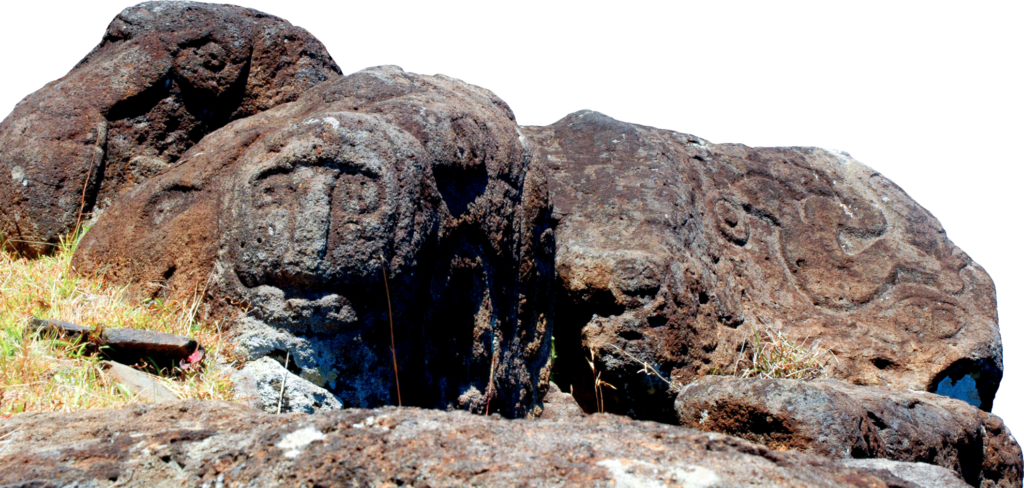
The village of Orongo, with its 53 oval houses aligned on the crater’s rim, housed participants during the month-long celebration. On its walls and on the rocks of the sacred area known as Mata Ngarau, more than 1,800 petroglyphs can still be seen today — representations of the god Make-Make, of the Komari, and of the Tangata Manu itself: figures with a human body and a bird’s head, some holding the sacred egg in an outstretched hand.
If you are planning a trip to Easter Island, the ceremonial village of Orongo is one of the most breathtaking sites on the island and the main stage of this ancient story.
The Tangata Manu and the peak of the Bird cult
Its apogee was after the arrival of the first Europeans, when the Tangata-Manu competition at Orongo reached its maximum expression. It is altogether possible that the arrival of these European ships simply confirmed to the Islanders the truth behind their religious beliefs, transforming it into a type of ‘cargo cult,’ incorporated in the ritual symbols found in the rock art at Orongo. The ritual came to an end with the depopulation of the Island, the arrival of missionaries and the imposition of Christianity on the demoralized survivors of a once great civilization.
The last competition is believed to have taken place between 1866 and 1867, in the presence of Brother Eugenio Eyraud and Father Gaspar Zumbohm. Once the missionaries saw the Ao dance with the egg outside their homes in Hanga Roa, they declared the practice demonic and it was abolished.
Frequently Asked Questions about the Tangata Manu
What does Tangata Manu mean?
Tangata Manu means ‘bird-man’ in the Rapanui language. It was the title given to the warrior chief whose representative was the first to find the sacred egg of the Manutara (sooty tern) on the islets in front of Orongo. The winner governed the island’s resources for one year.
Where did the Bird-Man ceremony take place?
The ceremony took place at Orongo, the ceremonial village built with basalt slabs on the southwestern rim of the Rano Kau volcano crater, in the southern tip of Easter Island. The islets of Motu Nui, Motu Iti and Motu Kao Kao, visible from there, were the destination where the Hopu Manu swam in search of the sacred egg.
How long did the Tangata Manu ceremony last?
The Tangata Manu competition was held for approximately 200 years, between 1680 and 1866. It was abolished when Catholic missionaries arrived on the island and considered the ritual incompatible with the Christian baptism of the Rapanui people.
Who is Make-Make in Rapanui culture?
Make-Make is the most important creator god in Rapanui mythology, an avatar of the Polynesian god Rongo. He is the principal deity associated with the Bird-Man cult and is represented in more than 1,800 petroglyphs on the rocks at Orongo. The Manutara bird was considered his sacred messenger.
What was a Hopu Manu?
A Hopu Manu was the athlete designated by each warrior chief (Matato’a) to compete in the Bird-Man race. He had to descend the cliffs at Orongo, swim to the islets and find the first egg of the Manutara. The Hopu Manu needed to be an extraordinary swimmer with great endurance and agility.


