
By Dra. Naití Morales Serrano – Centro de Ecología y Manejo Sustentable de Islas Oceánicas (ESMOI)
Motu Motiro Hiva (Salas & Gómez Island) is a small island located 3,210 km from the American continent and 400 km east of Rapa Nui (Easter Island), its nearest territory. This islet of 0.15 km2 is characterized by its high level of endemism and great cultural value for the Rapa Nui culture. It is for this reason that in 2010 the marine park of the same name (Motu Motiro Hiva Marine Park) was declared in order to protect its biodiversity.

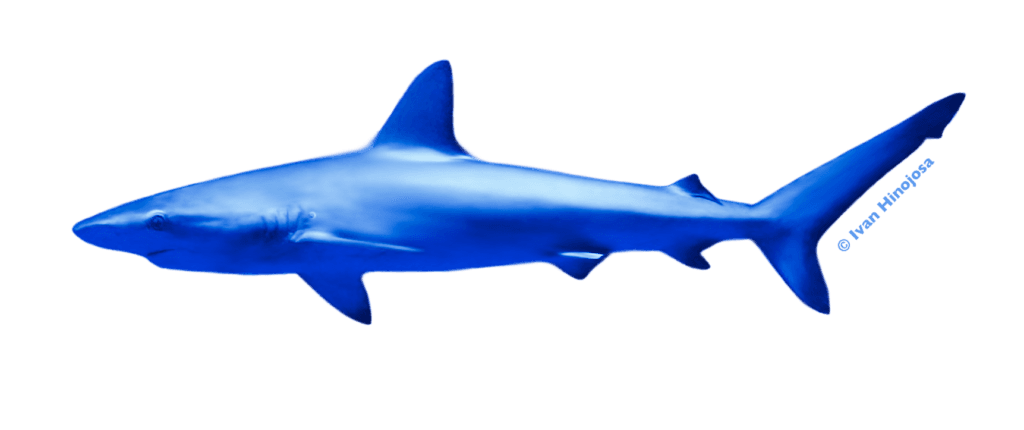
The high concentrations of large fish (also called top predators) that Motu Motiro Hiva hosts makes us think that it is still preserved as a healthy environment with little anthropogenic pressure. Among the species that inhabit this islet is the presence of the Galapagos shark Carcharhinus galapagensis. This species, known by the Rapa Nui people as Maŋo, is the only shark that resides permanently and throughout the year, both in Rapa Nui and Motu Motiro Hiva. Furthermore, previous studies suggest that this shark could travel between the two islands using the seamounts as actual highways, and that they would therefore be closely related.

Maŋos have a wide geographic distribution, inhabiting mainly the oceanic islands of the Pacific, Indian and Atlantic Oceans. This patchy distribution, coupled with shark characteristics (long-lived, naturally low abundance, slow growth and low birth rate) make mangos especially vulnerable.

Sharks (a term that colloquially includes sharks, rays and chimaeras) inhabit all the seas of the planet, as well as some rivers. However, they are the group of fish facing one of the greatest extinction crises, with one in three species at risk. In order to contribute to the conservation of these species, the IUCN (International Union for Conservation of Nature) Specialist Group developed an innovative approach that identifies and delimits critical areas for different shark species around the world. The distribution and subsequent identification of Important Shark and Ray Areas (ISRAs) is not random, but responds to four criteria and seven sub-criteria.

For example, criterion C corresponds to “Life History” and includes five sub-criteria: reproductive, feeding, resting, movement and aggregation areas. This same approach has already been used for the identification of important areas for mammals (Important Marine Mammal Areas; IMMA) and birds (Important Bird and Biodiversity Areas; IBA).
As part of this project, 74 ISRAs were proposed in the Central and South American Pacific Ocean in 2022. However, only 67 of these were proclaimed, five of which are located in Chilean territory (one in the Easter Island ecoregion, Motu Motiro Hiva Island).

Después de una amplia revisión bibliográfica, el criterio por la cual Motu Motiro Hiva fue declarada como ISRA fue de “área importante para la reproducción” del tiburón de Galápagos, debido a la presencia continua de neonatos y juveniles. Esta área representaría la zona de crianza más al sur-este jamás registrada, jugando un papel fundamental en la distribución de esta especie. Sin embargo, la población que habita Motu Motiro Hiva es una de las más remotas del mundo, con pocos lugares que la puedan subsidiar en el caso de desaparecer, por lo que protegerla se hace esencial.
In addition, two other areas, the Nazca & Salas & Gómez submarine mountain range and Rapa Nui, were identified as potentially important. However, these did not have the necessary ecological information to be established as ISRAs. The Salas y Gómez Ridge and the Nazca Ridge are two mountain ranges of volcanic origin located in the southeastern Pacific Ocean. The area includes more than 110 seamounts and two islands (Rapa Nui and Motu Motiro Hiva), with pelagic, benthic and abyssal habitats. The area includes part of the Exclusive Economic Zones of Chile and Peru, as well as international waters. This mountain range is thought to have potential as a staging and aggregation area for threatened species such as the Mako shark (Isurus oxyrinchus); potential restricted-range species of Juan fernandez dogfish (Squalus sp.); a potential breeding and undefined aggregation area for the bluebonnet (Prionace glauca). On the other hand, several studies suggest the presence of another reproductive area for the mango around Rapa Nui, especially the southeastern side of the island where large concentrations of juveniles have been observed. Because of the above, more studies focusing on these areas are needed to highlight their importance for sharks, rays and chimaeras. We hope that by the next review in 10 years this information will be available.


