by Ignacio Diaz-Godoy & Jan Maximiliano F. Tapia-Guerra – Centro Científico ESMOI- Universidad Católica del Norte – Anillo BiodUCCT ATE220044
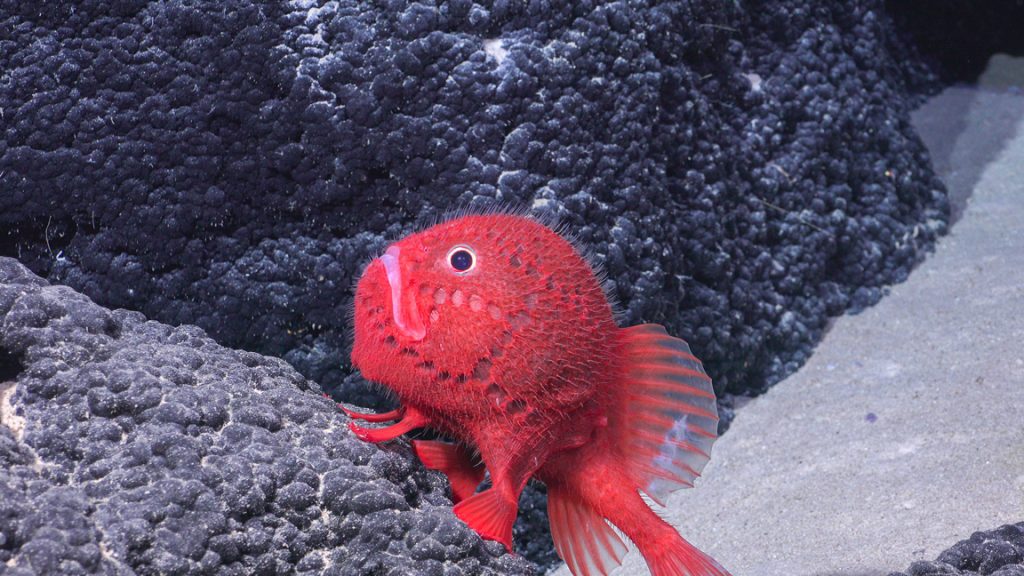
In the quietest realms of the Pacific Ocean, where sunlight dissolves and pressure becomes overwhelming, dwell creatures that seem to have stepped out of a fantastic tale. Along the hidden flanks of the Nazca, Salas and Gómez, and Juan Fernández ridges, the Chaunacidae -also known as sea coffin fish-glide slowly. With their round bodies, loose skin, and large, fixed eyes, they might appear tender, almost cartoonish. But beneath that charming facade lies an extraordinary biological machinery.


Until recently, we knew very little about them. Only two species had been recorded in the South Pacific, thanks to Soviet expeditions in the 1970s and 80s. But today, thanks to modern scientific campaigns aboard the oceanographic vessel Falkor (too) of the Schmidt Ocean Institute and the advanced technology of the ROV SuBastian, the ocean has begun to reveal more. And what we discovered was as strange as it was fascinating. During the 2024 expeditions, 45 individuals were recorded: some already known, others potentially new to science. They were observed in the depths, resting on sandy bottoms, hiding among rocks, or nestled within calcified coral algae. At depths exceeding 800 meters, species from the genus Chaunacops were found, such as the vibrant Chaunacops coloratus, which in adulthood adopts a fiery red hue, while as juveniles it is bluish-gray or pale pink. The enigmatic Chaunacops melanostomus was also spotted, with its mouth black as night and body dark as the volcanic rock it conceals itself within.

Closer to the light, between 300 and 700 meters, their cousins of the genus Chaunax appear. Among them, Chaunax sp. 1 stands out with its bright orange color and white freckles. This curious fish has only been recorded in the deep waters surrounding Rapa Nui and the Motu Motiro Hiva Marine Park, making it a possible endemic species of this remote region. Its relative, Chaunax sp. 2 -with a brown body adorned with irregular white spots-was found exclusively near Rapa Nui and might represent a species yet undescribed by science. Beyond their singular appearance, sea Coffinfish are masters of camouflage and patience. They are ambush predators: they do not actively swim to hunt, but remain still, as if part of the seafloor, until prey comes close enough.


Then, their inert body springs to life in an instant. One of their most remarkable weapons is their lure: a small appendage called the illicium, which projects from the head like a miniature fishing rod. At the tip of this filament lies the esca, a fleshy structure that mimics the movement of prey, drawing the unwary towards their enormous mouths. In some cases, the esca takes the shape of an arrow or is surrounded by cirri-fleshy filaments-that give it an almost vegetal or bioluminescent appearance.

But that’s not all. These fish are also equipped with an extraordinary sensory system. Along their flaccid, gelatinous skin runs a network of canals filled with neuromasts, receptors that allow them to detect vibrations and movements in the water-even in total darkness. Thanks to this “vision without eyes,” they can sense the presence of other organisms without needing to see them. It is as if the ocean itself speaks to them through their skin.

The habitats where they shelter-volcanic rocks, calcareous sediments, rhodoliths, and deep coral structures-are rich in biodiversity, yet incredibly fragile. The underwater mountains that run along the Salas and Gómez ridge and its neighbors act as submerged islands, driving the evolution of unique species and forming essential biological corridors for the marine connectivity of the South Pacific.

Exploring these hidden worlds is much more than gathering data. It is immersing oneself in a universe that challenges our ideas of what life can be. There, where darkness and silence reign, nature has created creatures that seem tender, yet are silent stalkers, perfectly adapted to hunt in the shadows. In their rarity, the Chaunacidae remind us that the ocean is a laboratory of wonders, and that every deep corner holds stories yet to be told.