
by Jan Maximiliano F. Tapia-Guerra – (Centro Científico ESMOI, UniversidadCatólica del Norte, Coquimbo.)

In the farthest reaches of the South Pacific, where the ocean seems endless and silence is as deep as the waters themselves, rises a nameless seamount from the abyss. It emerges like a sleeping giant, hidden beneath the surface near the Motu Motiro Hiva Marine Park, in the sacred and solitary waters surrounding Rapa Nui.


This seamount, part of the underwater Salas y Gómez Ridge — a chain of submerged peaks linking Rapa Nui geologically to the South American continent — remains unexplored, an unwritten chapter in the natural history of Chile’s ocean territory. Located over a hundred kilometers from the nearest land, its summit reaches up to 100 meters below the surface, at the threshold where sunlight still filters down, creating a mystical transition between darkness and light.

At its base, cloaked in eternal shadow, this undersea mountain harbors creatures barely known to science. Among them is a frogfish from the genus Lophiodes, with its strange body and luminous lure, patiently awaiting unsuspecting prey. Nearby, iridescent grenadiers (Ventrifossa spp.) drift like metallic ghosts, flashing silver-blue hues in the blackness. Coral forests of bamboo corals and the delicate, branching Primnoidae rise like antique chandeliers—fragile, ancient structures that bear witness to time itself.


But as we ascend the seamount’s flanks, a metamorphosis begins. We enter the mesophotic zone, a twilight realm where light lingers just enough to spark color and life. Here, the first vivid hues appear like whispers in the gloom. Brightly colored fish from the Callianthidae family glide past us, their flashes of orange and pink announcing that color will reign from here onward.

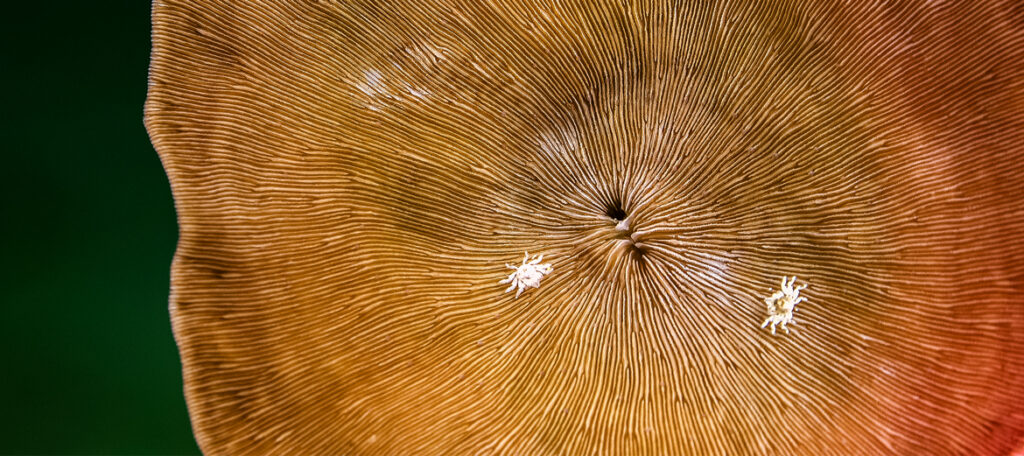
Whip corals, some stretching four meters long, sway with the ocean’s rhythm. Plate-shaped Leptoseris corals cling to rocks like delicate ceramic tiles. Pink-hued crustose coralline algae coat the seafloor, blending with vivid greens from leafy algae and nodules of living rhodoliths that form a vibrant mosaic teeming with hidden life.

And then — we reach the summit. At one hundred meters deep, sunlight still reaches the seafloor, and life bursts forth in astonishing abundance. Trumpetfish drift through the algae like golden ribbons. Robust and wary javelin fish patrol the rocky edges. Bright red soldierfish huddle in the crevices. Most stunning of all: massive schools of the black jack (Caranx lugubris) — a species emblematic of Rapa Nui — move like liquid silver, undulating in perfect unison. Surrounding them, Galápagos sharks patrol the summit with commanding grace, rulers of this submerged realm.

This hidden mountain doesn’t just connect depths—it connects stories. Many of the species we see here also live just 20 meters below the surface along Rapa Nui’s coast. The summit of this seamount is, in a way, an extension of the island’s coastal reef, a biological continuum that knows no borders. It is a living testimony to the ocean’s invisible threads of connection.
Though these waters are considered low in nutrients, they are rich in life. Here, in this nameless mount, lies a universe of secrets, unique species, and fragile ecosystems that we are only beginning to understand. This is not merely a geological feature — it is a beacon of biodiversity, a natural relic that reminds us that even in the planet’s most remote corners, life thrives in astonishing beauty and abundance.
To discover this seamount is to open a window into a hidden world, where science meets wonder. It calls on us to look downward — into the deep — where nature still keeps stories waiting to be told.


